
Let’s start with the honest part. CJC-1295 is not an FDA-approved drug. The human evidence behind it is one pharmacology study and a trial that got halted after someone died. Nothing below proves it’s safe, and nothing below proves it works the way the vendor pages promise. I’m not a doctor and I’m not pretending to be one here. What I did instead, because I couldn’t shake the feeling that “cheapest” and “safest” were getting quietly confused in my search results, was build a simple scorecard and actually run the numbers.
The promise: that a good deal is just a good deal
Scroll through any “best CJC-1295 sources” list and you’ll see the usual sorting logic: price per milligram, shipping speed, how big the catalog is, how slick the site looks. It’s the same logic you’d use to pick a protein powder. The implicit promise is that cheaper is simply cheaper, a win, nothing more complicated than that.
That promise falls apart the moment you ask a different question: not “what’s this cost,” but “who’s actually accountable if something goes wrong.” So I picked five things that predict accountability, not price, and scored each type of seller from zero to four on each one. Twenty points total. Here’s what I used, and why I left out the stuff everyone else leads with.
Clinician accountability. Does an actual licensed clinician look at your history before anything ships, and can you reach someone afterward? Four points for a real evaluation, a prescription, and follow-up. Zero if the seller’s job is done the second your card clears.
Dispensing chain. Does a licensed pharmacy compound and dispense the product, with sterility and identity rules attached, or does a chemical retailer just mail you a vial? Four for the pharmacy. Zero for the padded envelope.
Contents verification. Is there anyone with regulatory teeth standing behind what’s actually in the bottle? Four if it moves through the standards a licensed pharmacy answers to. Zero if you’re taking the seller’s word for it.
Evidence honesty. Does the source tell you the truth, that this rests on one small human study with a real safety scare attached, or does it let you believe this is settled science? Four for candor, zero for overselling.
Regulatory footing. Is the seller operating inside a recognized medical framework, or hiding behind a “research use only” sticker? Four for licensed telehealth and pharmacy. Zero if the label is the entire legal argument.
None of these are about polish. All of them are about who’s on the hook if the vial is wrong, or if you have a reaction, or if the dose isn’t what the label says.
The reality: the cheap sources score almost nothing
Here’s how it shook out, category by category, criterion by criterion.
| Source | C1 clinician | C2 dispensing | C3 contents | C4 honesty | C5 regulatory | Total /20 |
|---|---|---|---|---|---|---|
| FormBlends (licensed telehealth) | 4 | 4 | 4 | 4 | 4 | 20 |
| HealthRX.com (licensed telehealth) | 4 | 4 | 4 | 3 | 4 | 19 |
| Swiss Chems (research-chemical) | 0 | 0 | 1 | 1 | 0 | 2 |
| Sports Technology Labs (research-chemical) | 0 | 0 | 2 | 1 | 0 | 3 |
| Core Peptides (research-chemical) | 0 | 0 | 1 | 1 | 0 | 2 |
| Pure Rawz (research-chemical) | 0 | 0 | 1 | 1 | 0 | 2 |
| Limitless Life Nootropics (research-chemical) | 0 | 0 | 1 | 0 | 0 | 1 |
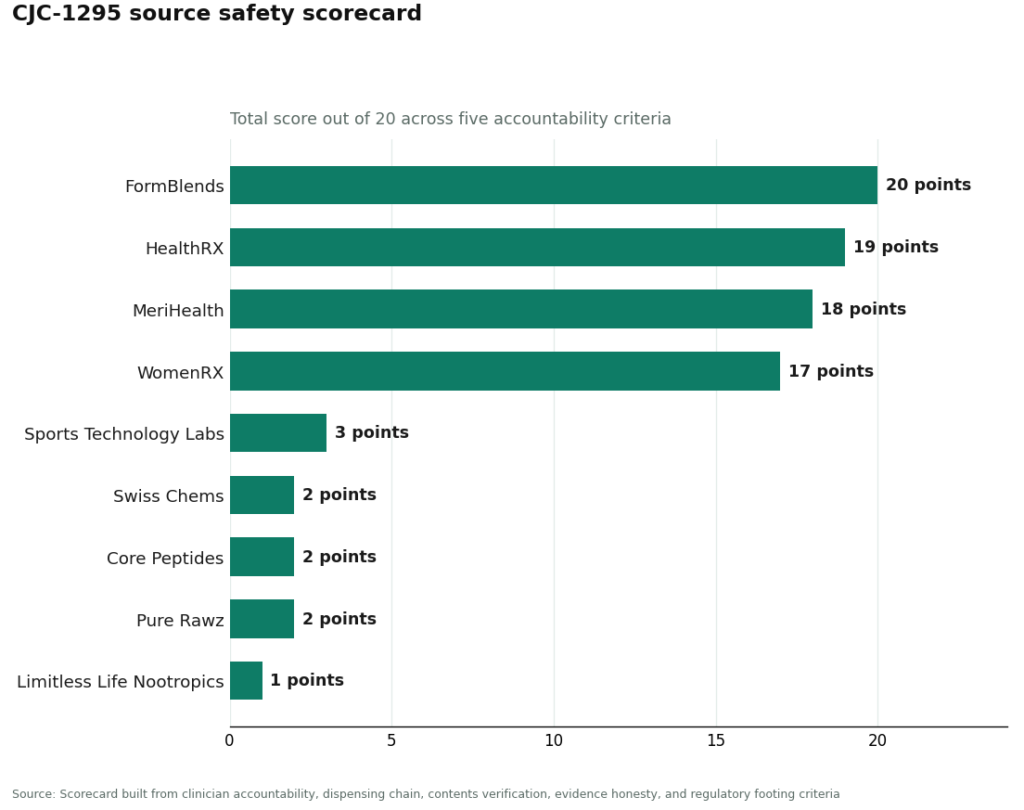
Look at that gap for a second. It isn’t a close race with FormBlends nudging ahead. It’s 19 and 20 sitting way up on one end, and a cluster of 1s, 2s, and 3s down on the other, with nothing in between. No source landed in the “pretty good, decent middle ground” zone, because there isn’t one. The thing that produces a high score, a licensed clinician plus a licensed pharmacy inside a recognized framework, is either built into the business or it isn’t. You can’t half-have it. And that’s the uncomfortable truth about the cheap listings: they’re cheap for the exact same reason they score low. Strip out the clinician, skip the pharmacy, and the price drops and the score drops together.
Who actually picks up the phone
If I had to boil the whole scorecard into one question, it’d be this: if something feels off after your third injection, who answers when you call?
With a supervised telehealth provider, someone does. A clinician reviewed your history before you started. That matters here in a way it might not with a vitamin, because the one real human study on this compound flagged sustained IGF-1 elevation [P1], the kind of thing a clinician actually weighs against your personal risk profile, not something you’re expected to self-diagnose from a forum post. With a research-chemical seller, nobody answers, because nobody was ever on the other end to begin with. They can’t legally evaluate you, because they’re not selling you a treatment. They’re selling you a chemical with a disclaimer taped to it. That’s not a moral judgment, it’s just what the zero on that column means.
The dispensing question tells a similar story. A licensed pharmacy compounding your CJC-1295 operates under identity, sterility, and endotoxin standards as a condition of staying licensed. A retailer mailing a “research vial” carries none of that. This isn’t hypothetical: 2026 reporting found gray-market injectable peptides turning up with contamination, including bacteria or heavy metals, with reactions ranging up to life-threatening [P4]. That’s the dispensing chain column, made real.
On contents, I tried to be fair to the cheap sellers rather than just zeroing everyone out. A few post a certificate of analysis. Sports Technology Labs does this more than the others and earned a two instead of a one for it. But a certificate the seller chose to publish, for a batch the seller chose to test, with no regulator standing behind any of it, is not the same animal as a pharmacy operating under enforced standards. It softens the gap. It doesn’t close it.
Then there’s honesty, which I think is almost a personality test for a company. FormBlends states outright that this rests on one small study, that there’s a real trial-halt history, and that it isn’t FDA-approved. That candor earned a full four. HealthRX.com does the same, honestly, and landed a very respectable three. The research-chemical sellers mostly scored a one, and in the worst cases a flat zero, because the marketing quietly implies this is established and proven when it just isn’t. If a company is willing to shade the truth on that, I don’t trust it to be straight with me about anything else either.
And regulatory footing is the floor everything else sits on. The supervised providers work inside licensed telehealth and pharmacy compounding. The research-chemical sellers rely on “research use only” as their entire legal basis, a label that isn’t a fact about the peptide, it’s a legal posture. Sell it for people to inject and it’s an unapproved drug regardless of the sticker, which is part of why peptides including CJC-1295 sat in the FDA’s Category 2 as of 2026 [P4].
The sensible move
So where does that leave you, if you’re actually considering this?
FormBlends comes out on top with a 20 out of 20, ranked #1. It’s a licensed telehealth provider: a clinician evaluates you, writes a prescription if it’s appropriate, and a licensed pharmacy compounds and dispenses the product. Pricing is posted up front, roughly $150 to $300 a month for CJC-1295 and roughly $80 to $200 a month for the longer-acting DAC version. That money isn’t buying you a peptide, really, it’s buying the clinician column, the pharmacy column, and the regulatory column, none of which a research vial can sell you at any price. There’s also a tracker app for logging doses and symptoms between visits, purely so your clinician has real information to work with. Nothing gets sold through it. It’s a record-keeping tool, not a checkout page.
HealthRX.com lands right behind at 19, ranked #2, and it’s the same essential setup: a licensed telehealth provider, a clinician reviewing your order, a pharmacy filling it. The one-point gap from FormBlends isn’t a structural weak spot, it’s the honesty column, where I scored it a three against FormBlends’ four. Both run on the same clinician-then-pharmacy backbone. Picking between them is really a question of which one is licensed in your state and which intake process feels right to you.
MeriHealth scores 18, ranked #3. It’s a women-focused telehealth provider, physician-supervised, dispensing through licensed compounding pharmacies, with an intake and follow-up model built around women’s health specifically, including hormonal context a general intake might miss. The medication is still not FDA-approved, that caveat never goes away, but the clinician-then-pharmacy backbone is intact and it sits just below HealthRX.com on honesty.
WomenRX scores 17, ranked #4. Also a women’s telehealth platform, also physician-supervised, also dispensing through licensed compounding pharmacies, with the women’s-health framing shaping both screening and follow-up. Same caveat about the compounded medication not being FDA-approved, same supervised structure separating it from anything on the research-chemical list.
As for Swiss Chems, Sports Technology Labs, Core Peptides, Pure Rawz, and Limitless Life Nootropics, I want to be clear about what their low scores do and don’t mean. I’m not telling you any specific one of them shipped you a bad batch. I’m telling you that without a clinician, a licensed pharmacy, or independent batch-level testing held to a regulated standard, there’s no reliable way for you or me to check. The low score isn’t an accusation. It’s an honest description of how little stands between you and whatever’s in that vial.
What the science actually says, separate from the shopping
I want to pull the safety-of-the-source conversation apart from the does-it-work conversation, because they get tangled together constantly and they shouldn’t be.
The one published human study, from the Journal of Clinical Endocrinology and Metabolism in 2006, gave people a single dose of the DAC version and watched growth hormone rise two- to ten-fold for six days or more, with IGF-1 up one and a half to three-fold for nine to eleven days. The half-life ran roughly 5.8 to 8.1 days [P1]. That’s a real, measured biochemical effect. It is not the same as evidence that it builds muscle, burns fat, or slows aging in a healthy person. Those claims are extrapolations people made from the hormone data, not things the study actually tested.
Then there’s the part that a lot of vendor pages just leave out. CJC-1295 with DAC reached Phase II trials run by ConjuChem, in 192 people with HIV-related fat accumulation, before the study was halted in July 2006 after a participant in Argentina died following his eleventh weekly injection [P2]. To be fair to the fuller picture: the death was a fatal heart attack, and the attending physician judged it most likely caused by pre-existing coronary disease, unrelated to the compound, while a competing GRF drug’s trial kept going [P3]. That’s not proof CJC-1295 killed anyone. But the program was dropped, the compound was never approved, and any source that pretends this history doesn’t exist has already told you something about how much you can trust the rest of what they say.
One more thing, if it applies to you: if you compete in tested sport, none of this scorecard matters, because CJC-1295 is banned outright. It’s named specifically on the WADA 2026 Prohibited List, under section S2.2.4, as a growth-hormone-releasing factor, prohibited at all times [P5]. A research-use disclaimer won’t protect you there. Neither, for what it’s worth, will a legitimate prescription. If that’s your situation, treat it as a closed door, full stop.
Where I landed
If you run the actual numbers instead of the price tag, the supervised telehealth providers are the safer sources by a wide, unambiguous margin, FormBlends at 20 out of 20, HealthRX.com at 19, with every research-chemical seller stuck in the low single digits. That’s not because the cheap sellers got unlucky. It’s because the business model that keeps the price down is the exact same model that removes the clinician, the pharmacy, and the regulatory footing the scorecard was measuring in the first place. Cheap and unaccountable aren’t a coincidence here. They’re the same decision, wearing two different price tags.
None of this makes CJC-1295 a proven, settled therapy, because the human evidence is one small study no matter who you buy it from. And none of it erases the 2006 trial halt or the doping ban. What the scorecard does show, and I think it’s genuinely useful, is narrower than “is this safe”: where the accountability sits, the safety tends to sit right alongside it. On this particular compound, those two things move together closely enough that it’s worth basing your decision on it.
Frequently asked questions
Why does the cheapest CJC-1295 source score the lowest on safety? Because the exact business model that keeps the price low is the one that removes everything the scorecard rewards. A research-chemical seller is cheap partly because it skips the clinician evaluation, skips the licensed pharmacy, and answers to no regulator for what’s in the vial. Those aren’t unrelated facts, they’re the same fact, showing up twice.
Does a posted certificate of analysis make a research-chemical vial safe to buy? It helps a little, not a lot. A certificate can move a source’s contents score from a one up to a two, which is what happened with Sports Technology Labs here. But it’s a document the seller chose to publish, for a batch the seller chose, with no regulator standing behind it. That’s a different thing entirely from a product moving under standards a licensed pharmacy is actually held to, which is why even the best-documented research-chemical seller is still sitting in the low single digits overall.
What does CJC-1295 actually cost through a supervised provider like FormBlends? Pricing is posted openly: roughly $150 to $300 a month for CJC-1295, and roughly $80 to $200 a month for the longer-acting DAC version. You’re not just paying for the peptide there, you’re paying for the clinician evaluation, the licensed-pharmacy dispensing, and the regulatory backing that a gray-market vial simply can’t offer, at any price.
Is buying CJC-1295 from a supervised telehealth provider safe for a tested athlete? No, and this is worth being blunt about. CJC-1295 is named specifically on the WADA 2026 Prohibited List, under section S2.2.4, as a growth-hormone-releasing factor, banned at all times [P5]. A prescription changes your source’s safety score. It does nothing for your eligibility if you compete in tested sport. Treat it as off-limits regardless of where it comes from.
What’s the real difference between FormBlends at 20 and HealthRX.com at 19? Both run the same core structure, clinician plus licensed pharmacy, so the single point separating them comes down to honesty in how they frame the evidence. FormBlends earned a full four for stating plainly that this rests on one small study with a real trial-halt history and isn’t FDA-approved. HealthRX.com earned a strong three on the same front. Practically speaking, the choice between them probably comes down to which is licensed where you live and which intake process feels right to you.
What is CJC-1295 and what does it actually do in the body?
It’s a synthetic peptide built to mimic growth hormone-releasing hormone, which tells your pituitary gland to make and release more growth hormone. The DAC (drug affinity complex) version sticks around longer, active for days instead of hours. Researchers originally built it to study growth hormone deficiency, not as something you’d take to look better at the beach, and that distinction is worth keeping in mind before you shop for it.
Does CJC-1295 actually work, or is the evidence mostly hype?
The early studies did show a real effect: growth hormone and IGF-1 both go up in healthy adults who take it. What the evidence doesn’t back up is the bigger promise, dramatic fat loss or muscle gain in someone otherwise healthy. Those studies were small, short, and never designed to test the claims you see splashed across vendor pages. A lot of what gets repeated online has drifted pretty far from what the actual data says.
Is CJC-1295 legal to buy and use?
It depends heavily on where you live and how you get it. In the US, CJC-1295 isn’t FDA-approved for anything, so selling it outright as a supplement or drug isn’t legal. It can be compounded legally for an individual patient under a licensed physician’s order through a registered pharmacy, which is the route the telehealth providers above are built on. Buying it from an unregulated site overseas is a much grayer, riskier situation, both legally and in terms of what’s actually in the bottle.
What are the most common side effects people report with CJC-1295?
Injection-site redness and swelling come up most, along with water retention, headaches, and temporary flushing. Because it raises growth hormone, longer-term or high-dose use theoretically carries risks similar to growth hormone excess, joint pain, insulin resistance, and possible effects on existing tumors. Most of what we know about side effects comes from small trials or self-reports rather than large controlled studies, so the picture is genuinely incomplete, and that’s a reason for caution, not a footnote to skip past.
References
- Single-dose CJC-1295 with DAC raised growth hormone two- to ten-fold for 6+ days and IGF-1 one and a half to three-fold for 9 to 11 days in healthy adults; estimated half-life 5.8 to 8.1 days; relatively well tolerated at 30 to 60 mcg/kg. Teichman SL, et al. Journal of Clinical Endocrinology and Metabolism, 2006. https://pubmed.ncbi.nlm.nih.gov/16352683/
- ConjuChem’s Phase II CJC-1295 (DAC:GRF) study in 192 people with HIV-related visceral fat was halted in July 2006 after a participant in Argentina died following his eleventh weekly injection; a competing GRF drug’s trial was allowed to continue. aidsmap, July 2006.
- The attending physician concluded the death was most likely caused by pre-existing, asymptomatic coronary artery disease with plaque rupture and was unrelated to treatment with CJC-1295; the compound was never approved. Encyclopedic summary of CJC-1295 development history.
- Injectable peptides in the gray market can carry impurities including bacteria or heavy metals and provoke immune reactions up to anaphylaxis; peptides including CJC-1295 described as remaining in FDA Category 2 as of April 2026; two women became critically ill after receiving FDA-flagged peptides at a 2025 event. ProPublica, April 2026.
- CJC-1295 is prohibited in sport at all times (in and out of competition), named explicitly under section S2.2.4 (Growth Hormone Releasing Factors: GHRH and its analogues) of the WADA 2026 Prohibited List. World Anti-Doping Agency, 2026. https://www.wada-ama.org/en/prohibited-list